A topic that I always find interesting is how to leverage human psychology into creating more immersive experiences for players.
So I decided to write this blog post on some research I did not so long ago.
Let’s first start by reflecting on this specific scenario. You and I each take out ten dollars, then we flip a coin, and the winner gets all the money. The loser gets nothing.
Would you play this game ?
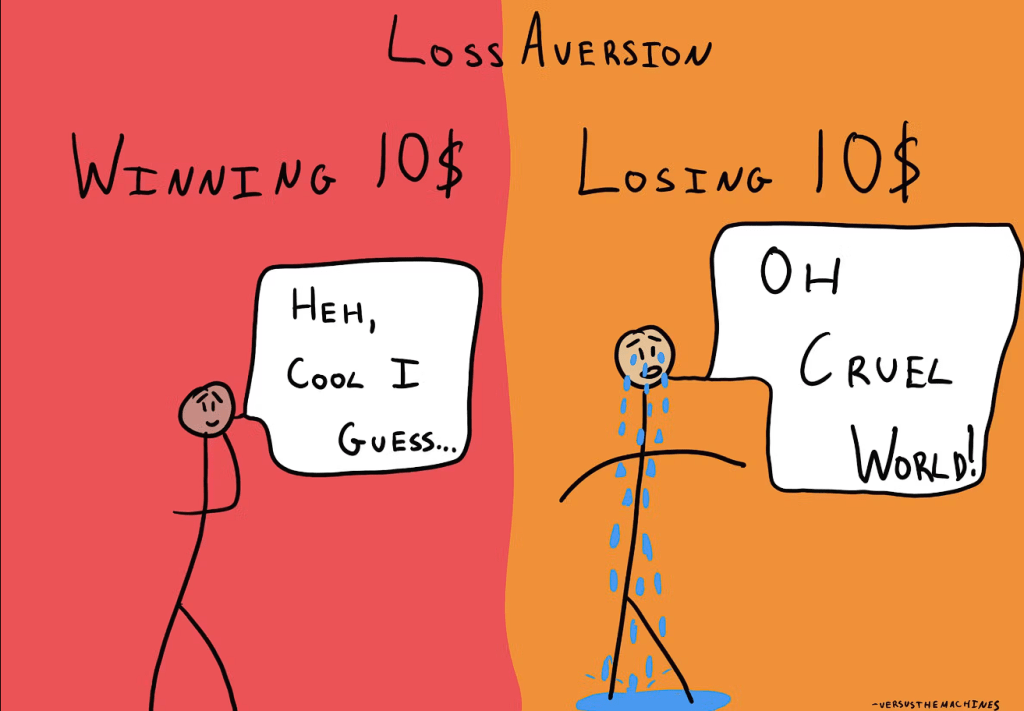
Personally I would not, because the prospect of losing that money outweighs the benefits, that is loss aversion.
Losing something makes you feel worse than gaining the same thing makes you feel good.
There are various reasons for this, one of them being that our brains evolved to detect or avoid danger, losing money or possessions triggers the same reaction, so it has an evolutionary purpose.
Another interesting component of human behavior can be demonstrated by the following example:
(Study performed by Daniel Kanhneman and Amos Tversky)
You have two options:
- Option A: 80% chance of winning $4,000 and a 20% chance of winning nothing
- Option B: 100% chance of winning $3,000
Which one would you choose ?
If you’re like most people then you would opt for option B even when told that the expectation value of option A is $3,200.
Let’s look at another one:
- Option A: 80% chance of losing $4,000 and 20% chance of losing nothing
- Option B: 100% chance of losing $3,000
92% of people answered option A. People preferred to go for option A which has a high chance of losing more money, but this brings us to another good learning.
People prefer a sure gain over a gamble for a larger gain, but they will gamble to avoid a sure loss.
An example I like bringing up to exemplify this is in a random event in the game “Slay the Spire”, players can eventually be ambushed by a group of bandits, they are then given two choices:

- Option A: Lose ALL your gold and skip the fight
- Option B: Enter a combat against the three bandits
This is an interesting event, however If I was to tally up the amount of times I decided to lose all my gold it would probably be around 10%.
This is because as a player it feels awful to lose all my gold, it triggers my loss aversion.
The question then is, should Game Designers avoid creating scenarios of Loss Aversion?
Let’s look at another game, in which you might recognize this cube.

In case you’re not familiar this comes from a game called Portal which was created by Valve.
In this game there’s a level where you’re given this cube, called Companion Cube, at the end of the level you’re told to drop it on this incinerator:

Funnily enough this moment is one of the most memorable moments in the game and one that took Valve’s developers by surprise with such a strong reaction from players.
The fact that you have to do that action is an emotional crux and triggers loss aversion on the player.
If someone else had done it for you, would it have become this memorable moment for a lot of players?
So going back to the question “should Game Designers avoid creating scenarios of Loss Aversion” ?
Not really, it can be a tool on your game design toolkit to elicit emotional reactions from players. Even if you don’t use it for such purposes it’s good to have it in mind when designing systems, it might be that players are not interacting with it due to loss aversion.
Loss aversion is at the root of a wide variety of human behaviors. Its extremely apparent when a person needs to make a decision. Games are an unique form or art where players are not a passive agent (such as when watching a movie) but they are active, and actively making decisions.
These decisions often change the outcome which a key part to trigger loss aversion.
![Endowment Effect – [miguel_marinheiro] avatar](https://miguelmarinheiro.com/wp-content/uploads/2024/01/photo01.jpg?w=40)
 [miguel_marinheiro]
Leave a reply to Endowment Effect – [miguel_marinheiro] Cancel reply