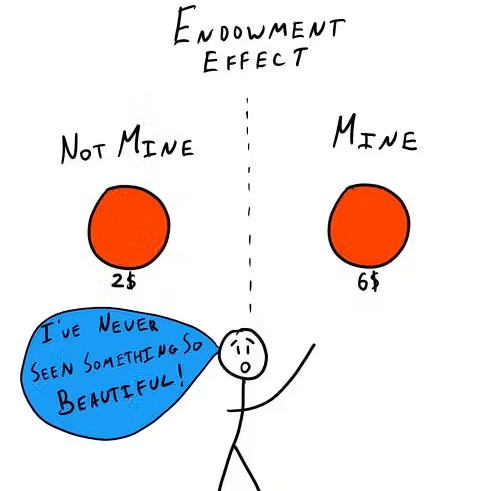
In my last post I spoke about Loss Aversion, in this one I’ll explore the endowment effect. This effect has been linked to be caused by two particular components, one of them is ownership over something and the other one is loss aversion over it.
So what is the endowment effect?
A quick google search will give you this definition “The endowment effect refers to an emotional bias that causes individuals to value an owned object higher, often irrationally, than its market value”.
One experiment on this was conducted by Knetsh and Sinden.
In this particular experiment participants were given either two dollars or a lottery ticket, this lottery ticket had a market value of two dollars as well.
Later, participants were offered the chance to trade the two dollars for the aforementioned lottery ticket or vice versa. The percentage of people that chose to do the trade was low, people were happy with what they already had.
There have been many experiments done on this, all with similar results, people were happy with the status quo, and will value the item they currently hold to a higher value.
How does this relate to games again?
Going back to our Portal example of the last post, there could be an extra reason on why losing the companion cube felt extra bad.
When you’re given the cube GLaDOS specifically says “Please take care of it”, GLaDOS gives you the cube, it endows you with it. This is important.
This sense of ownership over this object is one of the reasons why it also feels so bad to the player, by the time they reach the incinerator they would have had to carry the cube for lengthy durations effectively feeling like you owned the cube once you need to dispose of it.
There’s an extra nuance to the endowment effect that I didn’t mention earlier but is also important. Interestingly enough it doesn’t seem to happen with every type of goods. In a similar experiment to the one mentioned earlier, participants were given a token, and told that at the end of the experiment they could have a mug, eventually they weren’t offered a mug but a chocolate bar instead, in this case the participants didn’t value the token more than the object they were receiving, and made the trade.
This sounds useful for when you want people to disassociate the value of their possessions in order to make more trades… perhaps if you were to start some sort of business in which people traded money for tokens and then bet those tokens.
Ah right, those already exist and are called casinos.
So that is all to say that there are ways to avoid triggering the endowment effect to a good extent, in fact many mobile games use some sort of currency that you pay real money for which helps people disconnect from what they are actually spending.
Going back to more specific game examples, there are multiple games out there that have some sort of resource, and that resource can be used to build things like cities or armies (Total War – You can buy armies, X-Com you can recruit soldiers).
If you’re like me it often feels twice as bad to lose an army or soldier than losing the equivalent resource used to build them back up. In fact in X-COM you can keep playing the game after losing squad members and the game will still be beatable.
Fundamentally though you’ll feel worse by losing things that you’re connected to rather than “faceless” tokens/resources.
So something to keep in mind if you want to evoke strong emotions from players is to give them a sense of ownership of something, that will increase the perceived value in their head and thus potentially trigger a bigger emotional response, an important extra factor to this is that this ownership feeling is more intense if players felt like they worked for it.
This is akin to the difference between giving players a fully constructed base and having to maintain it in a game versus having to build the base from scratch. In the former players didn’t build a connection with the components of the base while in the latter they did.
That will be it for this one, hopefully this gave you a better understanding on why sometimes it feels worse to lose certain items in games than others.
 [miguel_marinheiro]
Leave a comment